A Real JPG Text Edit with a Serif Font
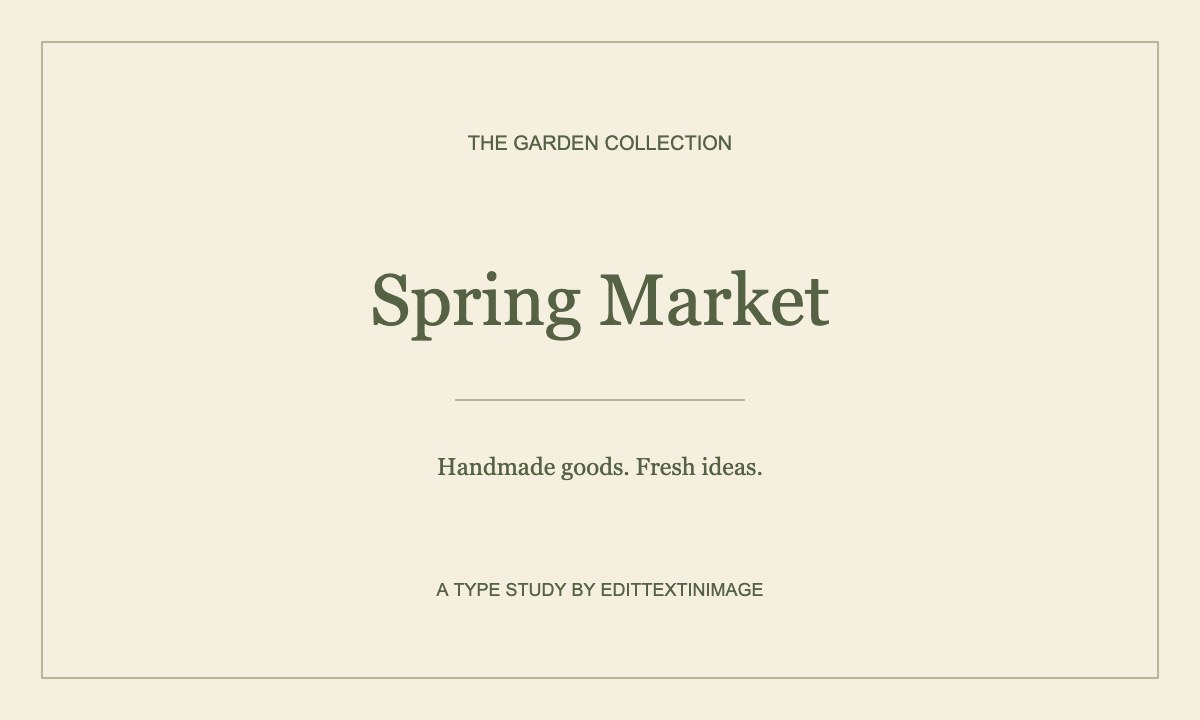
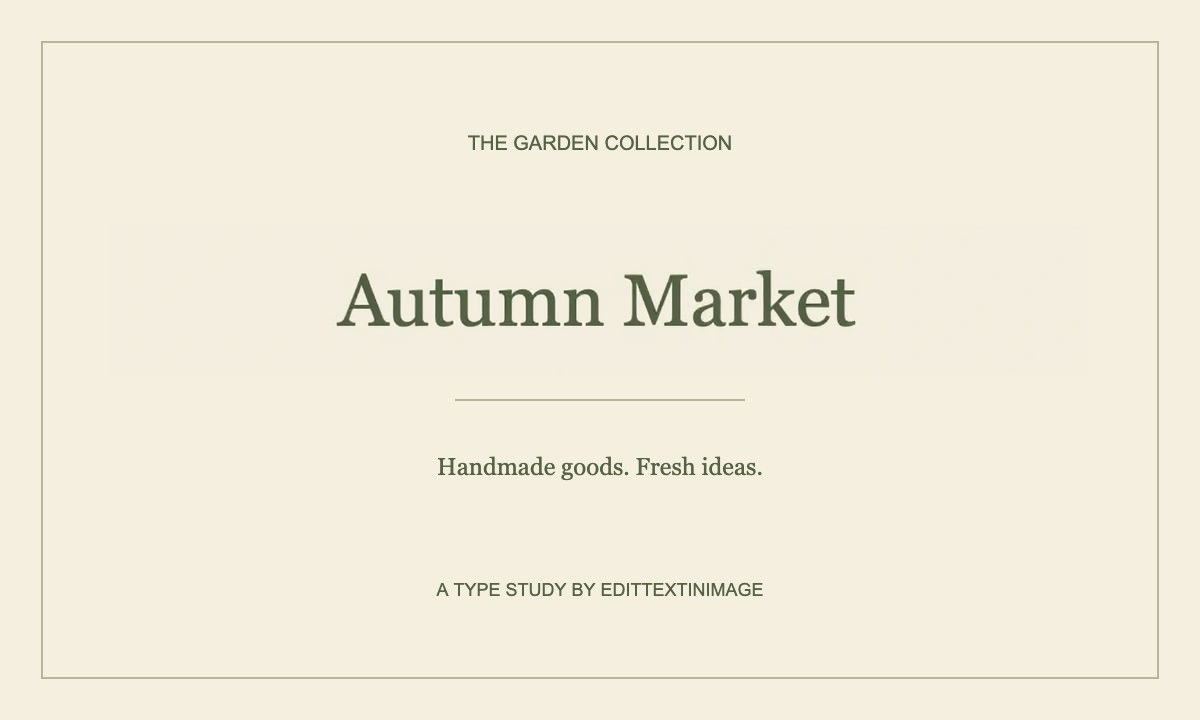
We exported this original poster as a JPEG at 88% quality, using 72 px Georgia for the title. The AI changed “Spring Market” to “Autumn Market.” Compare the letter shapes and the cream background below; the result keeps a similar serif appearance, but does not prove an exact font match.
Can You Edit Text That Is Already in a JPG?
Yes, but a JPG does not contain editable text layers. The heading, background, and decorative elements have been flattened into the same pixel image. Clicking a letter cannot bring back its original text box. A JPG text editor has to replace the old letter pixels and reconstruct the area around the new wording.
This tool combines those steps for one selected phrase. It uses the visible text as a reference for the replacement’s style, then places the edited rectangle back into your original image. It is useful for a small wording change on a flyer, exported graphic, or clear label when the editable source is unavailable.
JPG and JPEG refer to the same image format; both extensions work here. The important differences are resolution, compression, and the amount of usable background around the text. If you have the original design file, changing its live text is usually the better way to preserve exact typography. See the method guide before rebuilding a design that is still editable.
How to Edit Text in a JPG or JPEG Image
- Choose the best available JPG. Upload the original export instead of a copy downloaded from a chat preview. The file must be no larger than 10 MiB, with neither edge above 6,000 pixels and a maximum of 12 megapixels.
- Draw around one complete phrase. Include every letter and its effects, plus a small background margin. Exclude adjacent illustrations and other text. The box defines the part of the final image that can be replaced.
- Enter both text versions. Type the original words accurately, followed by your replacement. Keep it to a short single line. A similar visual width makes it easier to retain the existing layout without shrinking the lettering.
- Generate and inspect. Compare the before and after views. Check spelling, text weight, and the background under the old letters. JPEG artifacts can make the result appear softer than a clean source image, even when the wording is correct.
- Download the edited PNG. Keep the original JPG separately. Open the download at its full size before adding it to a presentation, website, or publication. The output remains a flat image and does not contain editable type layers.
You can use the JPG text editor online without signing up. Free edits depend on the daily allowance and shared service capacity. If an attempt fails, check the error and your selection before trying again; repeating the same request does not guarantee a better result.
Why JPEG Compression Affects Text Editing
Look for halos around the original letters
JPG compression can leave pale or dark fringes beside sharp text edges. When the original phrase is replaced, fragments of those fringes may remain if the selection is too tight. Include the full visible edge around the lettering and inspect the finished rectangle for old-letter traces. Avoid including unrelated details simply to make the box larger.
Start from a higher-quality export when possible
A low-resolution JPG may blend several small strokes into a single blurred shape. Enlarging that file creates more pixels, but does not reveal the missing original letter detail. Ask for the source export or use a clearer version before spending attempts on an image whose words are already difficult to read.
Keep realistic expectations for texture and gradients
Text on a plain card is different from text painted across a photograph. Within your selection, the model must rebuild the surface behind the old letters. Fine grain, repeating patterns, shadows, and photographic texture can change. The rest of the image comes from your source, but the selected background still needs your review.
To judge typography, compare the replacement’s height, weight, and baseline with nearby unchanged text. Our guide to keeping the original font appearance shows what visual matching means and why it is different from recovering the exact font file. A matching color alone does not establish a font match.
Why the JPG Text Editor Downloads a PNG
The source can be a JPG or JPEG, but this version exports PNG. That avoids applying another round of lossy JPEG compression when the edited rectangle is combined with the original. It does not repair compression artifacts already present in the uploaded image or turn blurry text into verified high-resolution lettering.
The PNG keeps the original width and height and may be larger in file size than the JPG. The browser composes the result from the decoded original image and the selected replacement. Pixels outside the box are retained through that composition; the original JPEG file’s metadata and compressed byte structure are not preserved as a JPEG export.
If your publishing system requires JPEG, keep the downloaded PNG as your master and convert a separate copy in an image editor. Check small lettering again after conversion. If the image is really a captured interface, the screenshot text workflow provides more specific advice for dense labels and neighboring controls.
JPG and JPEG Text Editing Questions
Does this work with both .jpg and .jpeg files?
Yes. Both extensions represent the JPEG format. Choose a static image within the upload limits. The editor also accepts opaque PNG and WebP images, so you do not need to convert those formats to JPG before using it.
Can I change text without the original font?
You can request a visual match from the image itself. The model tries to retain the lettering’s style, size, and color, but it does not identify or load the original typeface. Use a source design with the correct font when an exact match is required.
Can I add text instead of replacing existing words?
This workflow is for replacing visible text in a selected area. It requires original and replacement wording. If you want a new caption in an empty space, a conventional image editor with a text layer gives you more direct placement and formatting control.
Will the download be a JPG?
No. The current download is PNG at the original image dimensions. It avoids an additional lossy save during composition. Convert a copy afterward if JPEG is required by your destination, and review the converted file before publishing.
Will it fix blurry or heavily compressed text?
Not reliably. The model may infer a plausible shape, but missing detail makes exact lettering and styling uncertain. Use a better source when possible. Do not treat a visually cleaner output as proof that the text has been reconstructed correctly.
What happens to my uploaded image?
The original is opened in your browser. A crop around the selected text, including some surrounding context, is sent for AI processing. Results are temporary; download the finished image before leaving the page. The privacy page explains processing and retention.
Give your JPG new wording
Use your clearest JPEG, review the replacement, and keep a full-size PNG copy.
Edit my JPG